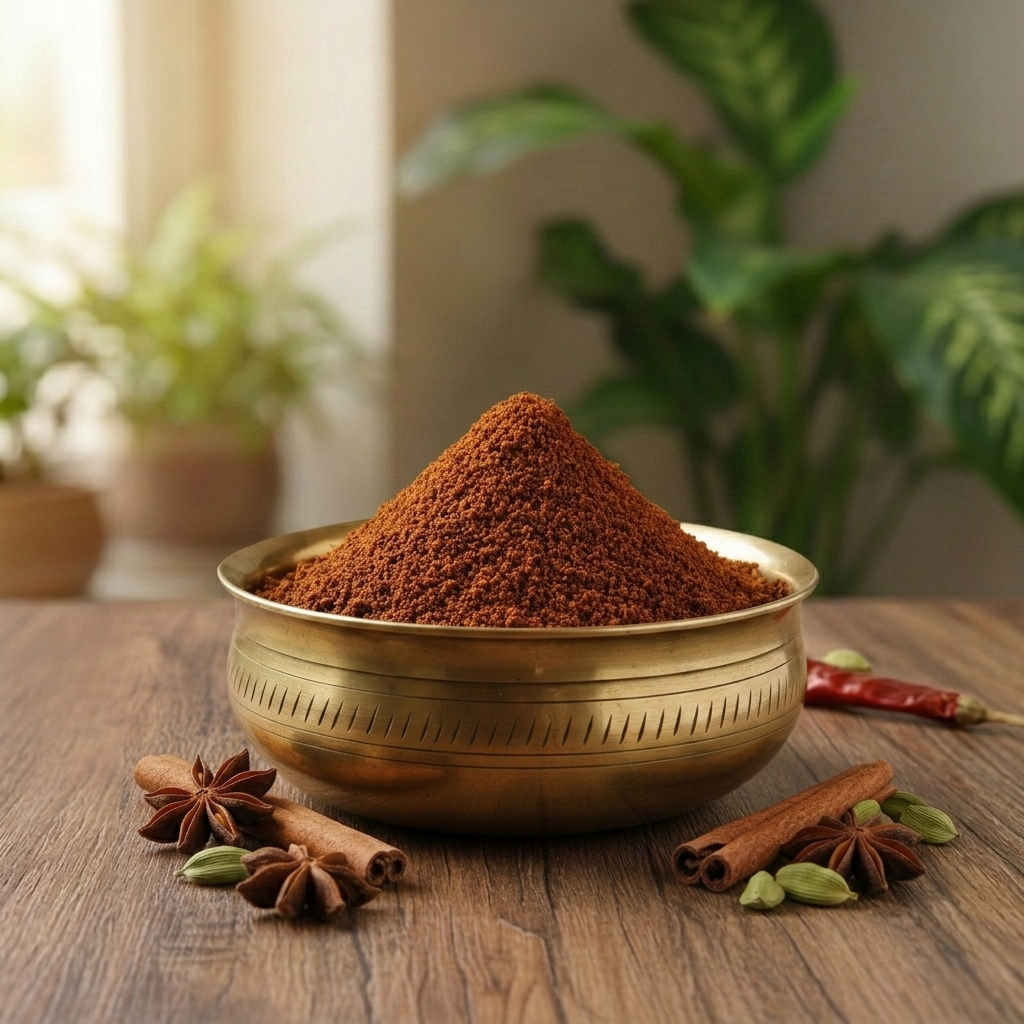
Open almost any Indian kitchen and you’ll find a jar of garam masala. But in Maharashtrian homes, there’s often a second jar next to it, darker and deeper in colour: kala masala. At first glance they seem interchangeable. They aren’t. Swap one for the other and your dish will taste noticeably different.
Here’s how the two compare, and when each one belongs in your cooking.
What is Garam Masala?
Garam masala is a warm, fragrant spice blend used across North Indian cooking. Recipes vary from family to family, but it usually leans on whole spices like cardamom, cinnamon, cloves, black pepper and cumin. It’s typically added toward the end of cooking, as a finishing touch, so its aroma stays bright and fresh.
Think of garam masala as the perfume of a dish: it lifts and rounds off flavours that are already there.
What is Kala Masala?
Kala masala (“black masala”) is a traditional Maharashtrian blend. Its name comes from its dark colour, which comes from roasting the spices until they turn deep and toasty before grinding. The result is a robust, earthy and slightly smoky masala with real depth.
Unlike garam masala, kala masala is usually cooked into the dish, in the tadka or the masala base, so its flavour builds the dish from the ground up rather than finishing it.
Garam Masala vs Kala Masala at a glance
| Garam masala | Kala masala | |
| Origin | North Indian kitchens | Maharashtra |
| Colour | Light to medium brown | Dark brown to nearly black |
| Flavour | Warm, aromatic, fragrant | Deep, earthy, smoky, robust |
| Preparation | Spices usually lightly toasted | Spices roasted until dark |
| When it’s added | Near the end of cooking | Early, as part of the masala base |
| Role in a dish | Finishing touch | Foundation of flavour |
Both blends vary by family, region and recipe, so treat this as a general guide rather than a rulebook.
And what about Goda Masala?
If you’ve heard of goda masala, you’re not imagining things: it’s another Maharashtrian blend, and people often mix it up with kala masala. Goda masala is generally milder and a little sweeter, while kala masala is bolder and more intense. Many Maharashtrian households keep both and choose depending on the dish.
When to use Kala Masala
Kala masala shines in dishes where you want a deep, rustic masala flavour:
- Misal: the spicy usal or tari that gives misal pav its character
- Bharli vangi: stuffed brinjal with a rich, aromatic filling
- Usal and sprouts dishes: moong, matki or any sprouted lentil curry
- Aamti and dals: a spoonful adds depth to everyday dal
- Everyday sabzis: potatoes, cauliflower, peas and more
A good rule of thumb: add kala masala while the dish is cooking, and add garam masala just before you take it off the heat.
Our favourite way to use it: Masala Khichdi
If we had to pick one dish that shows what kala masala can do, it’s masala khichdi. A spoonful turns a plain one-pot comfort meal into something deep, warm and full of flavour.
Serves: 3 to 4 | Time: about 35 minutes
Ingredients
- 1 cup rice and 1/2 cup split moong dal, washed and soaked for 20 minutes
- 1 onion and 1 tomato, finely chopped
- 1 cup chopped vegetables (peas, carrots, potato)
- 1 tbsp ghee or oil
- 1 tsp mustard seeds, 1 tsp cumin seeds, a pinch of hing, a few curry leaves
- 1/2 tsp turmeric
- 1 tsp Ambayuh Kala Masala
- Salt to taste
- About 4 cups water
Method
- Heat the ghee in a pressure cooker. Add mustard seeds, cumin, hing and curry leaves.
- Add the onion and cook until soft. Add the vegetables and tomato and cook for 2 to 3 minutes.
- Stir in the turmeric and kala masala and cook for 30 seconds so the spices release their flavour.
- Add the drained rice and dal, salt and water. Mix well.
- Pressure cook for 3 whistles, then let the pressure release on its own.
- Serve hot with a spoonful of ghee, papad and curd.
Tip: Add the kala masala early, with the onions and vegetables, so it cooks into the khichdi rather than sitting on top.
Can I substitute one for the other?
Not really. Using garam masala in place of kala masala will give you a lighter, more fragrant dish without the deep roasted flavour. Using kala masala where a recipe calls for garam masala can overpower the dish. If you only have one, use less than the recipe asks for and adjust to taste.
The story behind Ambayuh Kala Masala
At Ambayuh, our kala masala comes from the recipes of Namrata Gupta, whose cooking began in a Maharashtrian kitchen before it grew to include Rajasthani flavours. We make it in small batches in Kota, Rajasthan, roasting the spices to the right depth and blending them in the proportions her recipe has always used.
It’s the same masala that has always flavoured the food at our family table, now ready to flavour yours.
Want to try it? Explore our kala masala and the rest of our homemade range at www.ambayuh.in.
Frequently Asked Questions
Is kala masala the same as garam masala?
No. Kala masala is a Maharashtrian blend made from roasted spices and has a darker, deeper, more robust flavour. Garam masala is a lighter, more fragrant blend usually added at the end of cooking.
Is kala masala very spicy?
It has more heat and intensity than garam masala, but the level depends on the recipe.
How should I store kala masala?
Keep it in an airtight container, away from moisture, heat and direct sunlight. Use a dry spoon every time.
Can I use kala masala in non-Maharashtrian dishes?
Yes. Try it in dals, vegetable curries, rajma or chole whenever you want a deeper, roasted flavour.